Part 1 – Awoken:
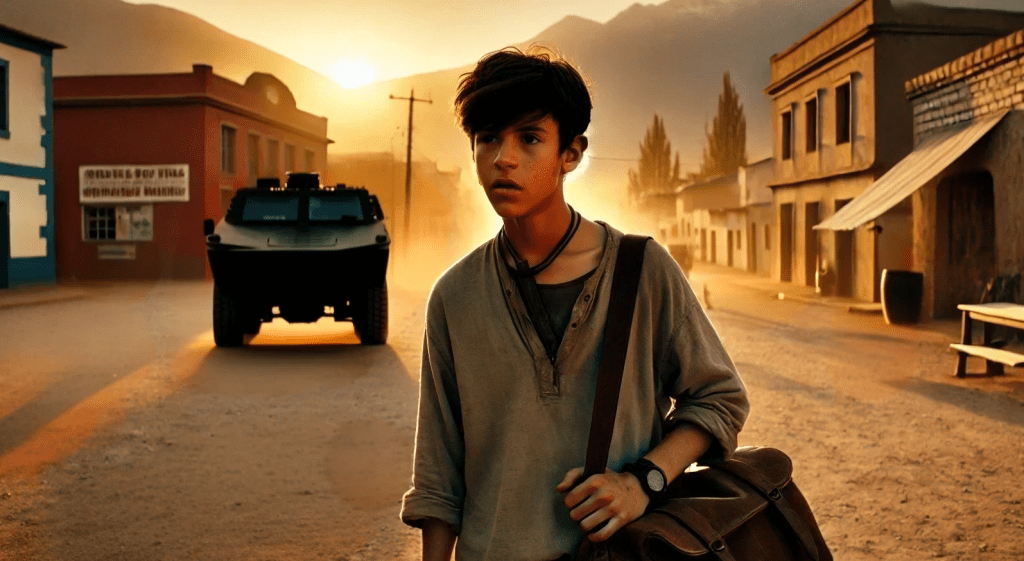
Enoch gazed out the window of an old passenger bus en route to northern Argentina. The smell of rust and stale air was present, as was the mild chatter amongst the other passengers, but Enoch’s mind remained elsewhere.
He was fixated on a nightmare that struck him in the early morning. The dream frightened him so much that it prompted him to leave his summer job for an 8-hour bus ride back to his hometown of Olaroz Chico, a small town that rested at the base of the Andes Mountains.
“It was just a dream…” he said under his breath as he pulled his worn leather duffle bag closer to him on the seat.
However, Enoch could not shake the dream’s lingering presence: the feeling of sadness, houses aflame, and the smell of something horrible burning.
“No,” he said quietly. “It was just a dream.”
He removed his hand from the rusted windowsill and placed it on the stone necklace resting on his chest. The stone rolling between his fingers rocked him out of his melancholy trance.
Suddenly, he felt the other passengers’ gathering eyes and realized he had been tapping his foot incessantly for several minutes. Embarrassed, he grabbed his knee with both hands, smiled graciously, and said, “Lo siento. I’m sorry.”
Enoch’s grandfather had always taught him to treat others with respect. A lesson he had not forgotten even when he was hundreds of miles away.
As it was every summer, his grandfather, or Abu, short for Abuelo, was an avid historian and religious elder who would send him away to a different archeological excavation site to work as a laborer and assistant. Abu believed it was important for Enoch to learn the history of their people. Enoch did not mind. He enjoyed the work. Besides, anything was better than being cooped up in his Abu’s cottage all summer studying dead languages, rituals, or history books. Enoch had even made friends with a few workers his age, Maria and Berto, in the past few months.
Enoch regretted not telling Maria he was leaving the campsite and hoped neither she nor Berto would worry.
“It was good to have friends,” Enoch thought.
His grandfather was the only family he had ever known. Although his memories are sometimes spotty, they have been filled with his Abu’s bearded smiles for as long as he can remember.
Enoch’s concentration was interrupted as a passenger suddenly shouted at the driver. Seconds later, the bus pulled to an abrupt halt.
He peered out his window, “I know this place.” Enoch said softly as he gazed across the street at the small-town market. It was a square he frequented with his grandfather every fall.
“My stop is next,” he mumbled quietly.
Several minutes later, Enoch stepped off the rusted old bus and onto a familiar dirt road. He glanced up at the mountain range in the distance and quickly spotted his favorite stone peak. He knew the time of day by the sun’s position on the rocks. Enoch smiled and inhaled the fresh mountain air before continuing down the path.
As he entered the outskirts of the village, he passed a tan house with a typical clay tile roof. An elderly villager stood outside and attempted to corral a chicken for his evening supper.
The elderly man heard Enoch’s footsteps and looked up with a frown.
Enoch smiled and waved at the man, “Buenas noches.” He said.
“Buenas noches, chico,” the elderly man nodded as he replied.
It was a small village, but Enoch and his grandfather were rarely included in the community. “Parias,” the villagers often called them. They were religious outcasts in a small house in the center of the village.
“It might as well be an island,” Enoch thought.
His grandfather would always say, “I was here first, then the village grew around me, or “It was not my fault that they decided to build a town in my backyard.”
He was as stubborn as he was wise, but Enoch loved him for it.
Enoch and his grandfather were the last descendants of an indigenous tribe known as the Ko’jala. Enoch often felt their presence made the villagers uncomfortable as a Christian community. Their religion was the oldest in Argentina. However, if you asked his grandfather about it, he would say it predated most world religions. It was a unique heritage with a rich culture, history, and language, much of which was unknown to today’s society.
He sighed as he continued carefully through the main square of the village. Nothing had changed since his departure several months ago.
He reflected on his summer at the archeological site and hoped he had not blown his opportunity. Enoch was working alongside Arthur Montag, an internationally renowned American archeologist. The dig site was thought to have been built by the Ko’jala people several hundred years ago. Enoch’s grandfather was hired as an advisor to oversee the excavation. Yet, his elderly condition made it difficult for him to travel. Fortunately, Arthur happily welcomed Enoch as a replacement.
“It was the job of a lifetime,” he thought. Enoch had learned so much from Arthur in just a few months.
Enoch paused in the middle of the town square as he recalled the note he had pinned onto the flap of Arthur’s tent, “I hope Arthur understood why I had to leave,” he said quietly.
As he approached the end of the square, he peered down the block towards the local grocery. Enoch immediately spotted a black and blue military van parked a few hundred feet up the road. Twelve months ago, these military vehicles would have been unusual. However, since the increased reports of domestic terrorism, the Arginine military bolstered its presence across the countryside.
Enoch did not know much about the attacks; he rarely had access to a smartphone, the internet, or TV. From what he heard from people at the dig site, it sounded like locally organized riots, looting, and arson in small towns and villages across the countryside.
In general, Enoch did not mind the military presence. Before he left for the summer, he would watch the soldiers from afar as they walked the square. Enoch would fantasize about adventures in the Navy. He had always wanted to see the ocean.
Enoch continued down the street and noticed the soldier on the driver’s side had hung his hand out the window.
Enoch smiled as he approached the car, “Buenas noch…” Enoch stopped abruptly and dropped his duffle bag.
The soldier’s head was tilted to the side, and an open gash across his neck oozed with blood.
Enoch gasped. His heart began to race as his breath shortened. He wanted to scream for help, but he could not speak. His eyes remained locked with the deceased soldier.
Suddenly, he heard a yell and the sound of shattered glass echoing from the grocery across the street.
He could barely make out the conversation until he heard the pained voice of the store owner shout out his grandfather’s name.
“Abu…” Enoch said softly.
As he turned to run, two burly arms grabbed him from behind. One arm reached around his head and promptly covered his mouth. Enoch struggled, but he could not move.
He glanced back at the military van for help only to see that a puddle of blood had now formed in the street as it dripped from the lifeless soldier’s extended palm.
 J.R. Night